
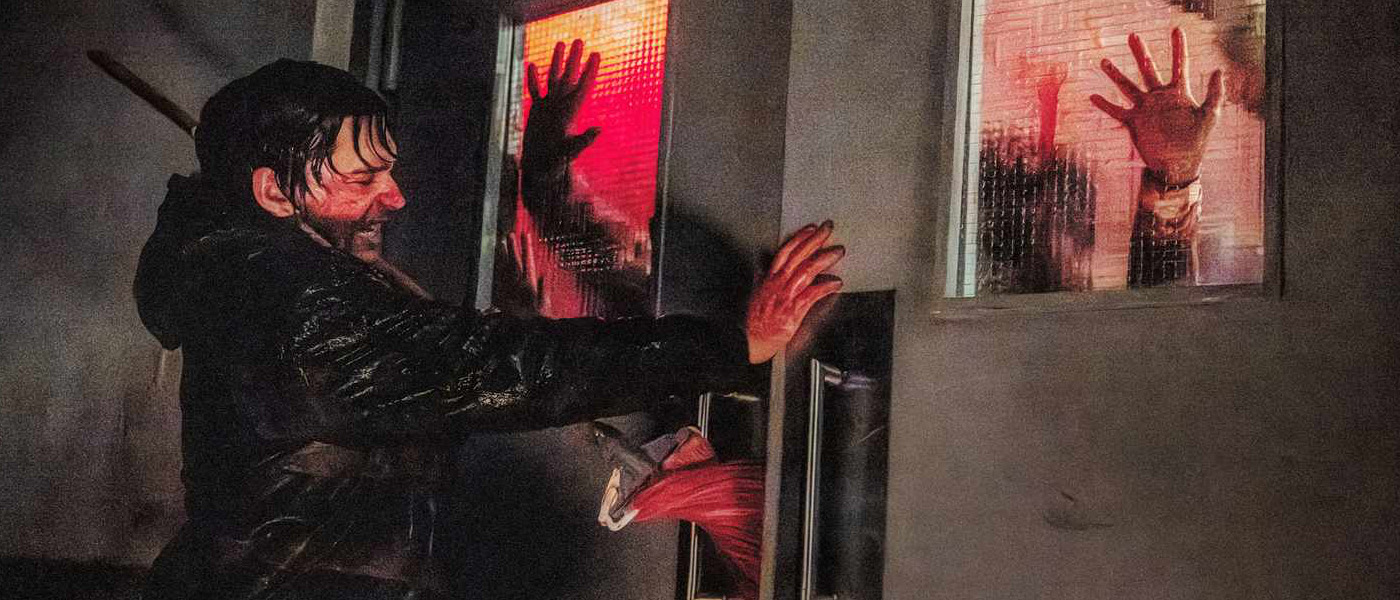
Zach Cregger did not make a simple game-to-film adaptation with Resident Evil. To posit so would be to assume that fans of the franchise are easily placated. A green herb, a padlock with a diamond motif, a box of shotgun ammo in an odd drawer. Instead, Cregger draws on the player experience to replicate the feeling of picking up the controller and pressing “new game.”
What he did not account for entirely, perhaps intentionally, was playstyle preference. Resident Evil games tend to be divided into two broad categories, action horror and survival horror, with a few spanning the bridge and allowing the two to coexist. Cregger’s Resident Evil sits firmly in the camp of survival horror. The player, or, protagonist, must struggle to exist in an impossibly hostile environment. They must scrounge, forage, craft, invent, and scramble to make forward progress while their surroundings work actively against them.
This was the first time in personal experience I did not enjoy a film because of the way I game.
I am a survival horror fan. In truth, I fall somewhere in the middle, but when I think back to other franchise adaptations, what I enjoy most about them is not seeing myself represented on screen. These games allow the player to experience a balance of abject terror and borderline inhuman heroics, a balance I felt was lacking in this iteration.
What worked for me: Austin Abrams is a delight. He’s a fitting concoction of charming and disarming that makes for the ideal audience surrogate. In addition to our immediately endearing protagonist, Cregger paints a beautiful snowy, expansive yet claustrophobic landscape. We get to travel to different parts of the city, some that the virus, or whatever it is, has yet to touch, and others that it has ravaged. We are given a masterclass in worldbuilding without droning exposition. The monsters are wholly unique and hauntingly grotesque. Nothing is lifted directly from the games, yet could believably belong to the same universe, given the range and variation in mutations.
What didn’t work: We get it, it’s a videogame movie. I didn’t need the characters to reference it aloud. Multiple, schlocky times. The tension of the film relies heavily on jump scares in the first act, and while it moves away from quick screams, later tension is manufactured around the protagonist’s own incompetence. There are many concepts, characters, and creatures that are introduced, then quickly discarded, at a pace that felt like visual whiplash. The humor, while welcome at times, left a note of tonal dissonance when paired with the overall dreariness of the story.

But most importantly, where Cregger missed the mark in elevating this from a competent zombie flick to a true Resident Evil property was simply, hope. I understand this is a strange concept given the subject matter, but a loadbearing thread throughout the franchise lies with this ideal. In a capitalist society where a big, comedically evil organization not only has a monopoly on business but is actively destroying the world and people it claims to protect, one person has the power to make an enormous difference, even if it destroys them in the process. That is what I was missing. The concept that the everyman, someone who perhaps starts their journey as a bumbling mess, has the power to adapt and grow, and that in doing so, they can help their fellow everymen. If you’re thinking, “that’s unbelievably cheesy,” YES! EXACTLY! And we love Capcom for that.
Cregger’s Resident Evil left a bleak taste in my mouth. While it did honor the player experience throughout the first, and even second acts, there was no development. It felt very flat and one-note two thirds of the way in. As a massive fan of the franchise, I was left feeling that none of the things I love about Resident Evil were represented on screen. As a standalone experience, I can find little fault with Cregger’s film, but as a Resident Evil property, I was let down.